Tags

Showing posts with label CCDN231. Show all posts

Friday, 2 November 2012

CCDN231 P3 pics and video for second test


I also did the same test that was done by my tutor and took photos of before showing the sign on the candy jar which was the rebellion temptation and then the aftermath of that temptation.
Unfortunately not caught on camera but to fully simulate what I was going for I picked up the candy jar, read the sign, tried to open the lip first which was glued shut and after then decided to smash the candy jar in my act of rebellion. 


Friday, 26 October 2012

Smashing the candy

My tutor doing my rebellion experiment and smashing the candy jar in front of everyone, I did not ask for feedback after she smashed it but she seemed to enjoy the experience and of course she felt rebellious.   


Sunday, 16 September 2012

The Written Rational CCDN231


After researching how people put their shoes on, it was found that some people can put on their shoes quite rough and aggressively. To contrast this, I am going to create an environment of comfort.  Having an environment is very important when trying to create a comfortable mood. John E. Crowly in “The sensibility of Comfort” explains how the word “comfort” was frequently used in order to express the satisfaction and enjoyment with immediate physical circumstances. To incorporate this idea into my experiment, I am going to be having my environment being in the participant’s bedroom.
“To make up an environment of comfort, what after all could be more human than desires to be warm, and to have a cozy home?” Crowly, J. E. (1999, pg 750) – this idea was applied to the experiment for my activity. The initial testing involved the participants lying down on their bed. The purpose of this is to introduce the participant to a familiar environment and a place where they will experience an instant feeling/mood of comfort. As Goldberger (2009) states “we are most comfortable with what we know”. The next step involved altering the hearing sense. I put on relaxing music, had the blinds down to have a quieter environment and also put the blinds down to block out distractions from outside which completed my environment.
“Comfort alone, or ‘contentment’, if that term feels more natural to you, is enough some of the time, but not all of the time. What we need, more than anything, is to understand the importance of synthesis” (Goldberger, B. 2009). With this in mind I made sure to explain the reasons behind the environment and music to the participants before starting and then got the participants to lie down until they felt very comfortable but not to the point where they go to sleep. Once this was done I got the participants to put their shoes on without getting off the bed making them stay in a comfortable state.
The results of this experiment were interesting in the sense that the simple everyday activity of putting on shoes had changed due to the feeling of comfort being implemented with sound and enviroment.  Not so much how they put their shoes on but something to be noticed evidently was the approach to putting their shoes on which was in a very slow, lazy manner compared to normally putting on shoes in a very fast second nature way which is normally expected.
From this experiment I have come to find that by making a room which expresses comfort with familitary and a sense of comfort using feel and hearing as. As Farell (2009) states “Comfort is a low-key, steady-state condition. And people are animals designed for sensory stimuation”. It is very easy for someone to slip into a very comfortable state of mind and then this been shown in a physical way as a resualt with putting on shoes in a more slow manner, heightning the importance enviroments have on people aswel.
Bibliography:
Goldberger, B. (2009). Challange And Comfort. The Kenyon Review , 21-31.
Crowley, J. E. (1999). The Sensibility of Comfort. The American Historical Review , 165.

CCDN271: Photos and Sound (for final and chosen exercise)


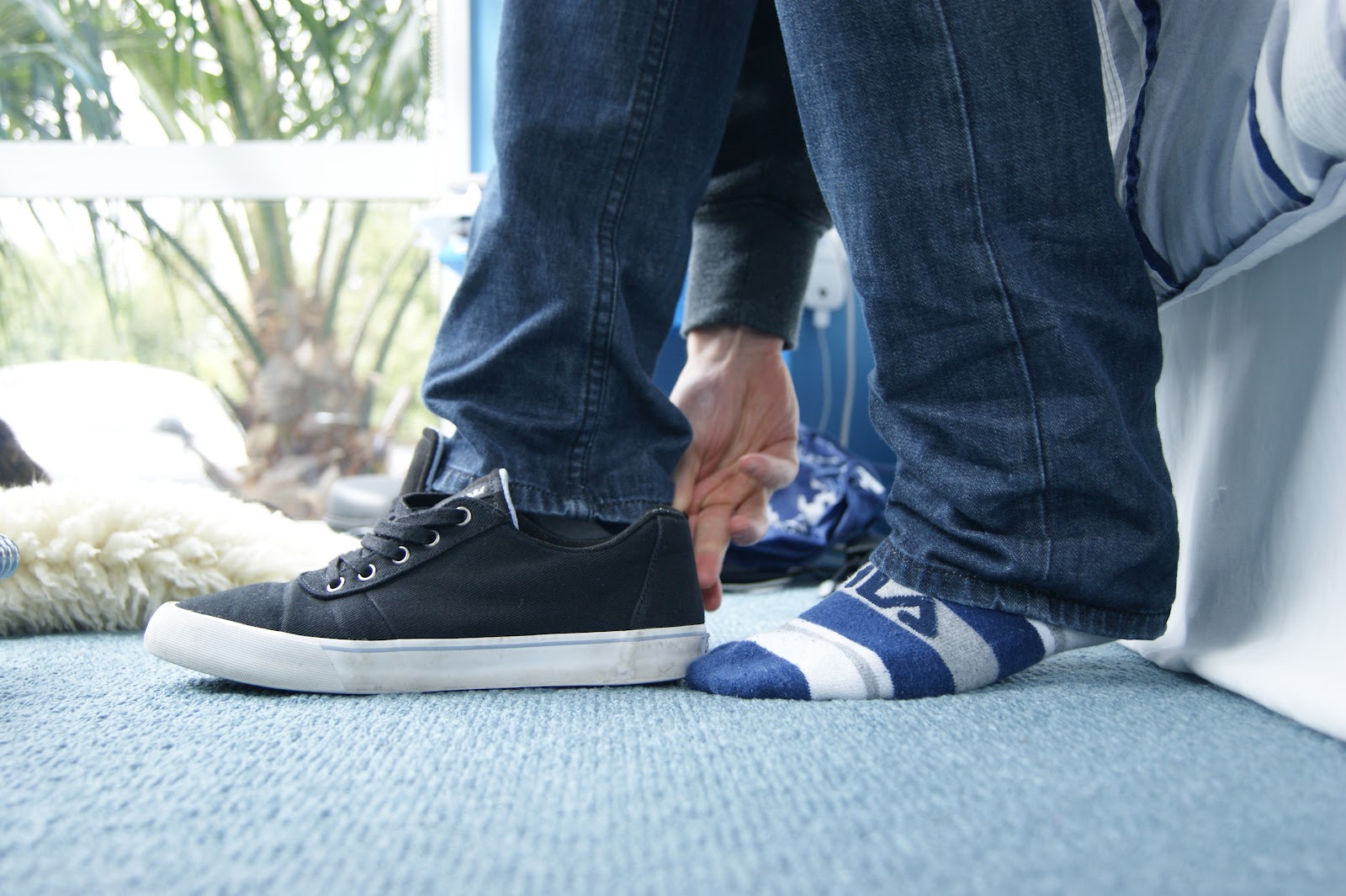
Showing the bed they were sleeping on and then points where they where putting on their shoes. I only had a picture of the bed they were sleeping on to avoid taking pictures of people resting on their beds. This person putting on their shoes relatively slower than in the last experiment. 


This person putting their shoes on with using their hands more for aiding their foot than just slipping it on.


With this interaction it was interesting that they went from sitting down to getting off the bed by the end of it but still showing signs of slowness like the other participants.


 The music that was played as the participants where resting for comfort.

Saturday, 15 September 2012

Experiment 2


Smell is a very strong sense to induce comfort so from this I got the idea to get incense candles and have the participants have the aroma of the candle fill the room before putting on their shoes. 


experiment 1

With my first experiment, looking at comfort I was thinking about other everyday things we do that are comforting and one thing that came to mind was having a shower. It is a very comforting relaxing experiencing atmosphere with mostly feel but also involving hearing and sound. The obvious problem was that it would be very weird to take photos of people having a shower. I wanted to keep this PG rated so I got the participants to be wearing togs and jump in the shower for 2 mins just standing there focusing on the comforting part of taking a shower and then after they dried themselves getting them to put their shoes on. Cant see this as something I will choosing as my main research but it was interesting. The participants explained how they did feel very comfortable and how it made them to put their shoes on in an "care fee manner"


Saturday, 18 August 2012

CCDN231: Variations


With my sense of putting on shoes the first one that I was sure I would end up using was a blind fold to take away the sense of sight considering that in my last few experiments the previous assignment most people tended to naturally look down at their shoes while they put their shoes on. While recording people doing this on my first attempt while making it basic and having people put their shoes on in the normal way they would and only changing it by having them close there eyes to take away sight. I noticed that there was a change in their co-ordination but not a lot they seemed to rely on feel a little bit more but it wasn’t a struggle for them at all. After this I then decided to experiment a bit more and make them more un comfortable when doing this and make them put their shoes on again but with a blond fold on and on the edge of a step. This came out with interesting results as the fact that they were on the very edge of the step seemed to put them off a significant amount and I noticed that they would wobble a bit more than usual and take longer to put their shoes on more slowly and carefully. A failed attempt I had which didn’t have a lot of good feedback from is when I got them to put their shoes on blindfolded without being able to use their hands at all so restricting them to just their feet with the sense of sight still being taken away. I thought that this would put a few people off considering quite a few people use the aid of their hands but as soon as their foot touched the shoe they instinctively knew what to do. A final test that I did was to test a more extreme situation and to get people to put on their shoes again with the blind fold but to put them in a very bizarre an unnatural situation and have them put their shoes on a moving object, using a long board for this. This made it very difficult just because of the movement for some of them and the movement and the “fear” that they could not properly put on their shoes too easily distracted them. From all of these experiments I have found out firstly the obvious that it is hard to put your shoes on, blindfolded on a ,oveing object. But also a big factor with these expiriments was confidence. It was an easy task at hand but if the people where out of there element and doing an everyday task in an un ordinary was their confidence falted which impacted heavily on their ability to do the task at hand. 

EDIT: This was completely wrong. starting over.

Thursday, 16 August 2012

Pictures of the 5 people putting on shoes.

This is from person 1-5 in order and it helps explain the paper test. (which photos of did not work unfortunately)